
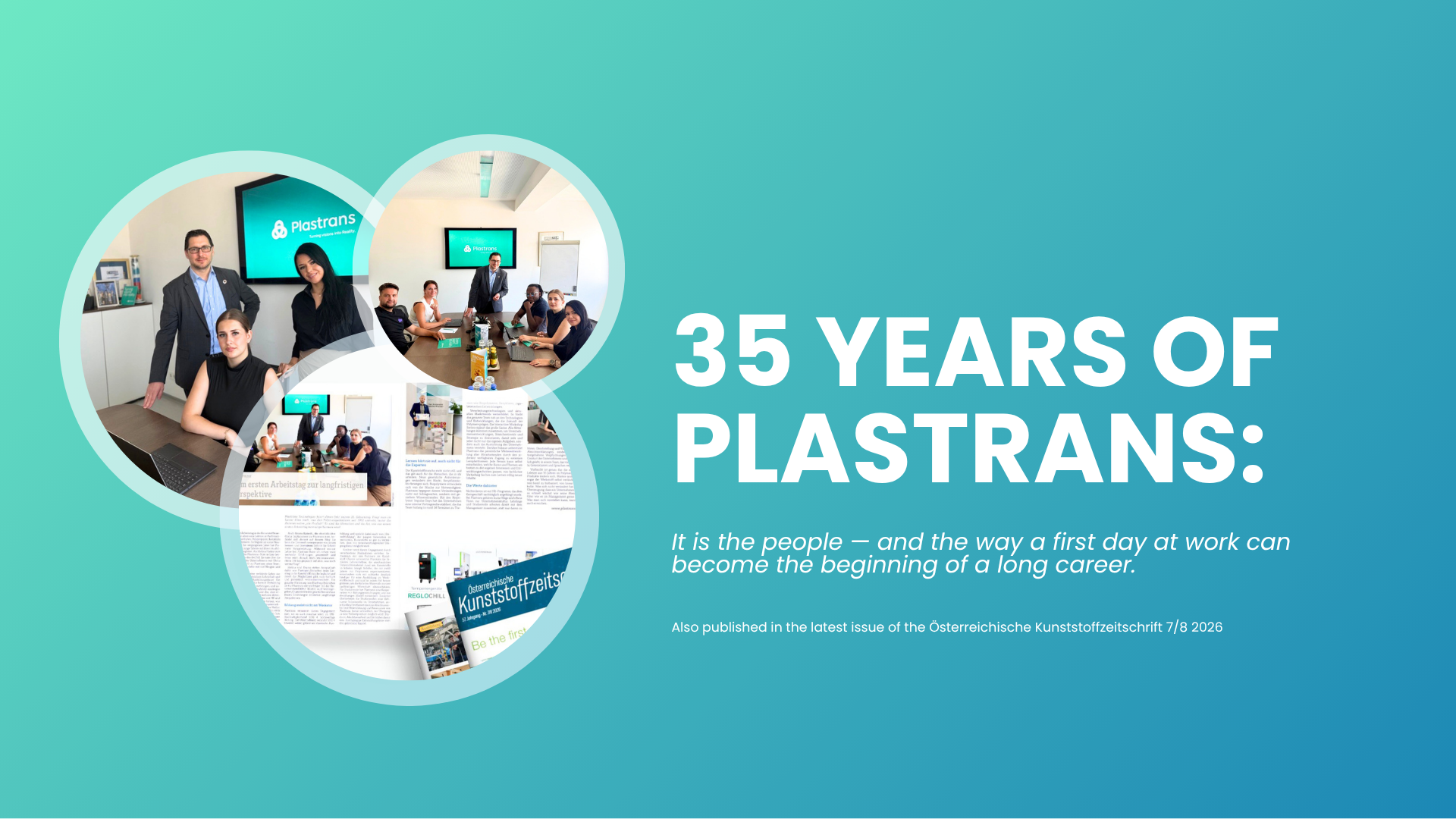
Plastrans Technologies is celebrating its 35th anniversary this year. Ask around the Linz office what has driven the polymer specialist since 1991, and the answer is rarely “a product.” It is the people — and the way a first day at work can become the beginning of a long career.
A first day in the plastics industry is, above all, a lesson in technical vocabulary: polyethylene, polypropylene, recyclates and biopolymers. At the beginning, much of it is unfamiliar territory. Over the years, Plastrans has supported two young talents on their professional journeys. When Melina Hadzic first walked into the Plastrans office in Linz, that was exactly where she stood. She joined Plastrans through the company’s cooperation with GLORIA Implacement e.U., with no previous experience in the industry, but with plenty of curiosity and a clear plan.
The plan was an accelerated apprenticeship as an office administrator, covering the same curriculum as a regular apprenticeship but in a more compact period. It is an option for people who already have previous education or professional experience and want to enter a new field more quickly. It was demanding, but successful. Melina worked across several departments, supporting the HR and Sales teams and learning from the inside how an internationally active polymer company operates. Today, she is a permanent member of the team.
“I am proud of how far I have already come, and thanks to the support of Plastrans, I am looking forward to the successes that still lie ahead.” (Melina Hadzic)
Erjona Kabashi is currently on a similar path. She is getting to know the company’s processes from the inside and is gradually taking on more responsibility.
“During my apprenticeship at Plastrans, I have already gained many valuable experiences and I am looking forward to continuing to develop. I am excited about everything that still lies ahead.” (Erjona Kabashi)
Melina and Erjona are examples of how Plastrans supports people entering the plastics industry and gives them the opportunity to develop both professionally and personally. Supporting young talent is an important part of Plastrans’ corporate culture. Knowledge is shared, opportunities are created, and first experiences can develop into long-term perspectives.
Education Doesn’t End at the Workplace
Plastrans anchors this commitment where it can also be measured: in the UN Sustainable Development Goal SDG 4, Quality Education. The company deliberately takes a broader view of SDG 4 than traditional education and also refers to it as “environmental education”: helping the younger generation understand plastics well enough to make responsible decisions about their use.
This commitment takes shape through a range of initiatives. Together with partners in the Plastics Cluster, Plastrans supports the Lehrmittelbox initiative, which brings practical educational materials about plastics into schools. Students who experiment with polymers at the age of twelve are significantly more likely to choose a career in materials-related fields by the age of eighteen — and, in any case, are better equipped to understand the role of materials in a sustainable economy.
For university students, Plastrans has developed a cooperation model with educational institutions built around three stages. First, students take on a defined part-time position within the company. They then complete their thesis with the support and resources of Plastrans, before potentially moving into a full-time position. Studies, thesis and career therefore form one continuous development path rather than three separate chapters.
Learning Never Stops — Not Even for the Experts
The plastics industry never stands still, and neither do the people working in it. New regulatory requirements are changing the market, recycled material markets are evolving, and biopolymers are moving from niche applications towards becoming a necessity. Plastrans responds to these changes not with buzzwords, but with targeted knowledge sharing.
With the Biopolymer Impulse Days, the company has established an internal series of presentations that has so far provided the team with around 14 sessions covering topics such as biopolymers, recyclates, regulatory developments, processing technologies and current market trends. This keeps the entire team close to the technologies and developments shaping the future of polymers.
The Interactive Workshop Series complements this broader approach. Employees from all departments come together to discuss company developments, industry trends and strategy, ensuring that everyone understands not only their own responsibilities, but also the direction in which the company is heading.
Plastrans also supports the personal development of all employees through ongoing access to external learning platforms. Everyone can decide for themselves which courses and topics best match their interests and next steps in their development — from deepening their professional expertise to exploring completely new subjects.
The Values Behind It
None of this is an HR programme added to the business after the fact. At Plastrans, short communication paths and open doors are part of the company culture. Apprentices and students work directly with management rather than simply hearing about them from a distance.
Equality and diversity are not just statements of intent. They are written commitments in the company’s Code of Conduct and are lived every day in a team that brings together different backgrounds, generations and languages.
Perhaps that is the real lesson from 35 years in the polymer business: products change, markets change, and even the materials themselves are changing — from fossil-based to bio-based, from linear to circular.
What has not changed is the belief that a company can only grow as fast as its people.
Or, as it is often said in management: What you can imagine, you can achieve.
For 35 years, Plastrans has kept learning. Perhaps that is exactly the point.

You are currently viewing a placeholder content from Vimeo. To access the actual content, click the button below. Please note that doing so will share data with third-party providers.
More InformationYou are currently viewing a placeholder content from YouTube. To access the actual content, click the button below. Please note that doing so will share data with third-party providers.
More InformationYou need to load content from reCAPTCHA to submit the form. Please note that doing so will share data with third-party providers.
More InformationYou are currently viewing a placeholder content from Facebook. To access the actual content, click the button below. Please note that doing so will share data with third-party providers.
More InformationYou need to load content from reCAPTCHA to submit the form. Please note that doing so will share data with third-party providers.
More InformationYou are currently viewing a placeholder content from Instagram. To access the actual content, click the button below. Please note that doing so will share data with third-party providers.
More InformationYou are currently viewing a placeholder content from X. To access the actual content, click the button below. Please note that doing so will share data with third-party providers.
More Information