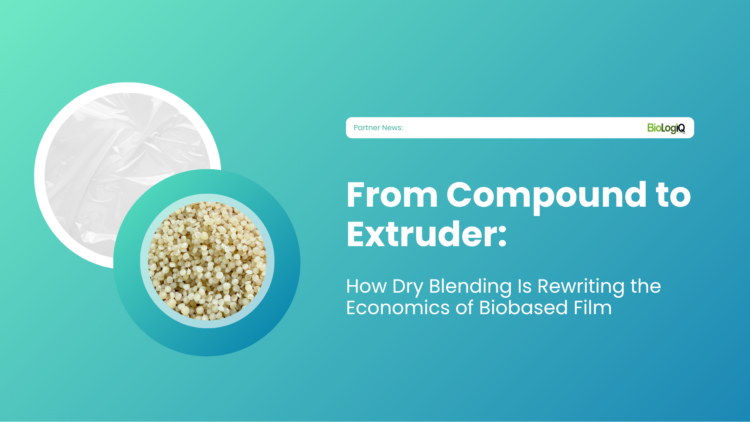

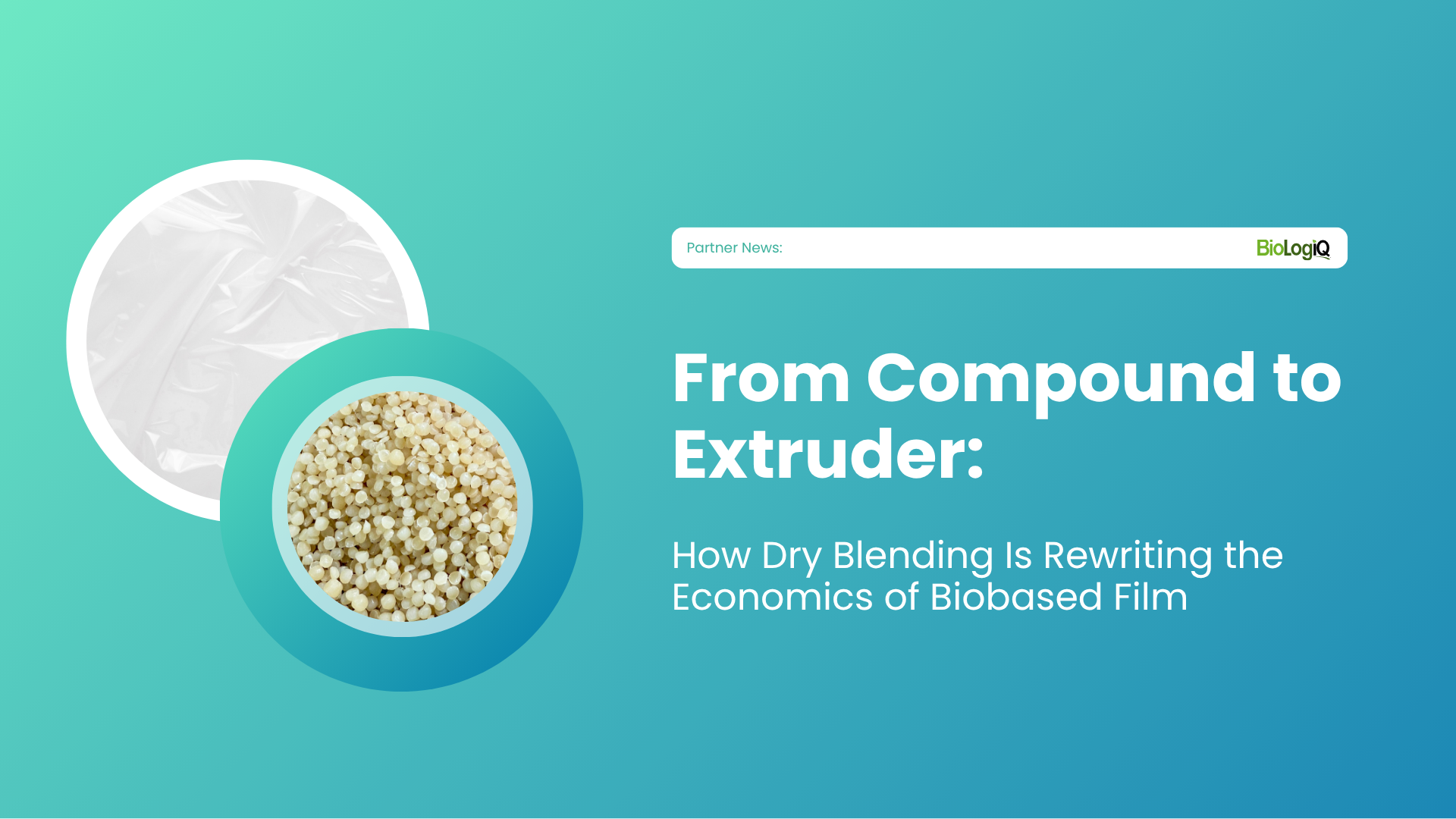
Our recent LinkedIn post introducing dry blending technology generated considerable interest across our network — a clear sign that this development is relevant to a broad range of film producers. We would like to build on that discussion with a development from our long-standing technology partner BioLogiQ, achieved together with blown film equipment specialist Reifenhäuser: the successful direct blending of BioLogiQ’s thermoplastic starch biopolymer NuPlastiQ™ at the extruder, eliminating the separate compounding step entirely.
On the surface, this reads as a process detail. In practice, it has meaningful implications for the cost structure and flexibility of biobased film production.
The problem with compounds
Most starch containing film applications today rely on pre-compounded material – typically, NuPlastiQ and the carrier resins are compounded in a fixed ratio in a compounding step. Depending on the application the such produced compound is either used as a masterbatch to be diluted or as is.
That step carries a measurable cost: on large scale compounding alone typically adds between 0.30 and 0.45 EUR per kilogram on top of raw material costs, before accounting for the overhead, logistics of shipping a compound, the inventory required to carry it, and the loss of purchasing leverage that comes from buying a finished blend rather than sourcing the raw polymers directly.
It also introduces a degree of inflexibility. Once a compound is fixed, the film producer is tied to whichever carrier resin the compounder used; fine-tuning film properties for a specific application, or switching to the material grade already run on other lines, requires going back to the compounder.
Feeding the ingredients straight into the line
BioLogiQ set out to test whether that compounding step could simply be eliminated — feeding NuPlastiQ, an LLDPE copolymer, and a compatibilizer directly into the extruder as separate components, rather than as a pre-made compound.
For the trial, they partnered with Reifenhäuser, whose EVO Fusion 5-layer blown film line is built around a twin-screw extruder for the core layer, originally designed for processing recycled PE, with the vacuum venting and melt-pump technology needed to handle multi-component feeds directly at the line.
The results, run at production-relevant rates of up to 470 kg/hr, were unambiguous. Films made by direct-feeding the individual components matched the benchmark compound on every measure that matters: transparency, mechanical tear resistance, and impact strength. Even a reduced compatibilizer dose, tested specifically to see how far the recipe could be pushed, still produced an acceptable film, just with somewhat more haze. Across the very first trial series, biobased content in the finished film reached up to 26.4%, with the door open to 30% and beyond.
In short: what used to require a separate compounding facility can now happen in a single pass, on equipment that many sustainable material converters will be interested in anyhow, or are already evaluating for other reasons.
Why this matters more than it looks
The cost savings from eliminating compounding is the headline. But we see at least three further implications that deserve equal attention.
Within the recipe NuPlastiQ occupies an intermediate position on the polarity spectrum — more polar than standard polyolefins, less polar than materials such as EVOH or polyamide. Blended directly at the extruder, this intermediate-polarity dry blend does more than contribute biobased content: it possibly can also function as a compatibilizing layer, supporting adhesion between polar and non-polar layers within the same multilayer structure. This opens doors for further investigations with respect to a tie-layer functionality.
The biobased-content conversation defaults, in many cases, to biobased PE — which carries a significant cost premium over conventional polyolefins. NuPlastiQ is priced well below that premium. Used as a dry-blended component within a biobased-PE film structure, it allows producers to reach the same biobased-content target at a meaningfully lower material cost, while retaining the „bio-based“ positioning that some customers specifically require.
The direct-feed, no-compounding approach that BioLogiQ and Reifenhäuser have validated for NuPlastiQ and LLDPE also establishes the technical basis for dry blending NuPlastiQ with compostable polyesters, again without a separate compounding step. Should this development proceed as the current trial suggests, it would make NuPlastiQ-based starch compounds substantially more cost-competitive and accessible to a broader base of film producers, extending well beyond the LLDPE-based applications demonstrated here.
Where this leaves film producers today
Notably, this does not require an entirely new type of equipment. The line configuration used in BioLogiQ’s trial was not modified, only the process parameters were adapted. For converters operating or evaluating equipment with the appropriate feeding and venting capability, the barrier to entry for direct-blended biobased film has been substantially lowered.
BioLogiQ regards this milestone as a starting point rather than an endpoint and continues to pursue further optimization together with Reifenhäuser.
As a long-standing distributor of NuPlastiQ across the region, Plastrans regularly discusses cost-competitive routes to biobased content with packaging engineers and procurement teams. This development is precisely the kind of advance we consider worth bringing to our partners‘ attention early.
To discuss whether direct dry blending is a fit for your line, or how NuPlastiQ could be applied within your current film structure, please contact our team. We are glad to walk through the technical details and, where useful, connect you directly with BioLogiQ’s experts.

Sie sehen gerade einen Platzhalterinhalt von Vimeo. Um auf den eigentlichen Inhalt zuzugreifen, klicken Sie auf die Schaltfläche unten. Bitte beachten Sie, dass dabei Daten an Drittanbieter weitergegeben werden.
Mehr InformationenSie sehen gerade einen Platzhalterinhalt von YouTube. Um auf den eigentlichen Inhalt zuzugreifen, klicken Sie auf die Schaltfläche unten. Bitte beachten Sie, dass dabei Daten an Drittanbieter weitergegeben werden.
Mehr InformationenSie müssen den Inhalt von reCAPTCHA laden, um das Formular abzuschicken. Bitte beachten Sie, dass dabei Daten mit Drittanbietern ausgetauscht werden.
Mehr InformationenSie sehen gerade einen Platzhalterinhalt von Facebook. Um auf den eigentlichen Inhalt zuzugreifen, klicken Sie auf die Schaltfläche unten. Bitte beachten Sie, dass dabei Daten an Drittanbieter weitergegeben werden.
Mehr InformationenSie müssen den Inhalt von reCAPTCHA laden, um das Formular abzuschicken. Bitte beachten Sie, dass dabei Daten mit Drittanbietern ausgetauscht werden.
Mehr InformationenSie sehen gerade einen Platzhalterinhalt von Instagram. Um auf den eigentlichen Inhalt zuzugreifen, klicken Sie auf die Schaltfläche unten. Bitte beachten Sie, dass dabei Daten an Drittanbieter weitergegeben werden.
Mehr InformationenSie sehen gerade einen Platzhalterinhalt von X. Um auf den eigentlichen Inhalt zuzugreifen, klicken Sie auf die Schaltfläche unten. Bitte beachten Sie, dass dabei Daten an Drittanbieter weitergegeben werden.
Mehr Informationen